- ▸ 8x8 grid, cluster pays. Land 5 or more connected matching gems horizontally or vertically to win.
- ▸ Tumbling reels. Winning symbols vanish, the rest drop down, new ones fall in, and tumbles keep going while wins form.
- ▸ Five spin modifiers sit behind coloured markers: Nuclear (blue), Wild Gem (pink), Squares (brown), Colossal Symbol (red), Lucky Wilds (green).
- ▸ Bets $0.20 to $240.00; the top-build RTP is 96.55% and the max win is 10,000x your stake.
- ▸ Bonus buy = 100x the base bet to trigger Gold Fever, which is a progressive multiplier feature, not a free-spins round.
Reviewed game
 Gems Bonanza (Pragmatic Play)
Play the game
18+ | T&C apply | Play responsibly
Gems Bonanza is an 8x8 cluster-pays slot: you win with five or more connected gems, winning symbols tumble away, and fresh ones drop in for more wins on the same spin. Stakes run 0.20 to 100. Here is exactly how clusters, tumbles, the five modifiers and the Gold Fever bonus work.
How Gems Bonanza works in one minute
You win in Gems Bonanza by landing 5 or more matching gems connected side by side on an 8x8 grid, and every winning cluster tumbles away so fresh gems can drop in and pay again. That is the whole loop: cluster, tumble, repeat, with five spin modifiers dropping wilds and giant symbols along the way. Bets run from $0.20 to $240.00, and this is a Pragmatic Play cluster-pays slot, not a payline machine. If you have never touched it, load the free Gems Bonanza demo first and watch a few tumbles before you stake anything.
Below we break down the grid, how a win forms, the tumble sequence, all five modifiers with their marker colours, the paytable, the bet range and the 100x bonus buy. We spent time in the demo checking each rule against the in-game panels, and the panels win over any second-hand figure.
Key takeaways
The 8x8 grid and how a win forms
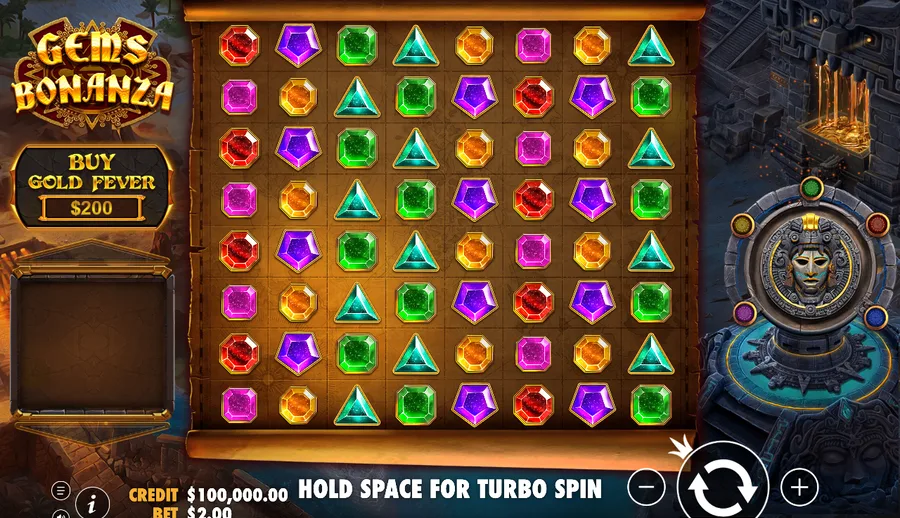
Gems Bonanza plays on an 8x8 grid of coloured gems, which gives you 64 positions rather than the reels and paylines you might expect. There are no lines to match across. Instead you win when 5 or more identical gems touch each other horizontally or vertically, so a cluster can bend and sprawl anywhere on the board.
Only the highest win per gem combination is paid, though if several separate clusters land on the same drop, all of them are added together. The more gems in a cluster, the bigger the pay, and the paytable scales in bands from 5 symbols up to 25 or more. That is the core of how Gems Bonanza works: no lines, just connected colour.
What counts as a connection
- Gems must share an edge, not just a corner.
- The minimum cluster is 5 gems; there is no maximum.
- Wilds fill in for any gem to complete or extend a cluster.
The tumble loop, step by step
Once a spin lands, the tumble feature takes over and it is where most of the action lives. Every gem that formed part of a win is removed from the grid, the gems above drop down to fill the gaps, and new gems fall in from the top. If those fresh gems create another cluster, the whole thing repeats.
Tumbles continue as long as new wins keep forming, or a spin modifier keeps changing the board. When the drops finally produce nothing new, the sequence ends. All wins from a spin are added together after the tumbles and any spin features have finished, then paid as one total. A single spin can chain several tumbles, and a good one can quietly stack a handful of clusters before it settles.
One spin. Many drops. One payout at the end.
The five spin modifiers and their marker colours
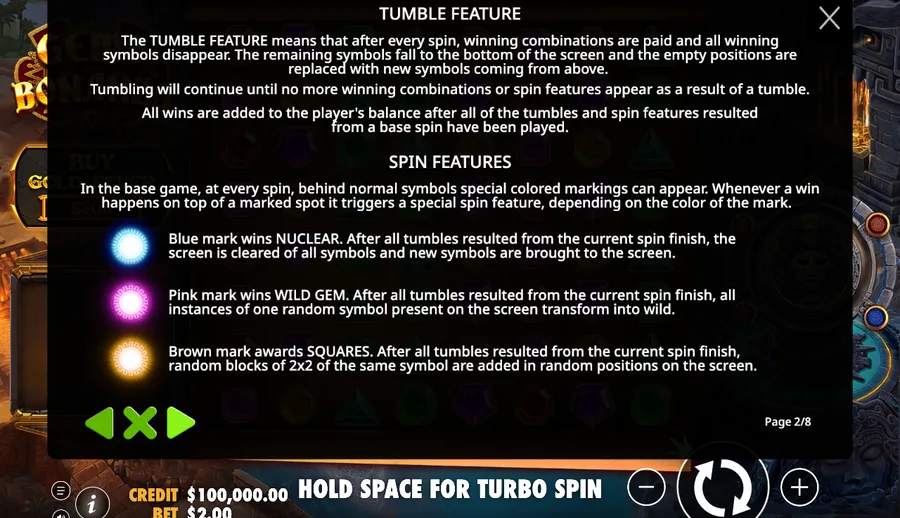
During the base game a coloured marker can sit behind a gem. When a win covers that spot, the marker fires its modifier once the current tumbles resolve. Each of the five has its own colour, so you can read the board at a glance. They punch up otherwise flat spins, and across our demo sessions the modifiers fired often enough that dead spins were rare (a small, unscientific sample).
What each colour does
- Nuclear (blue): clears the whole grid of symbols and brings in a fresh set.
- Wild Gem (pink): turns every instance of one random gem into a wild.
- Squares (brown): adds random 2x2 blocks of a single gem type.
- Colossal Symbol (red): drops one random 3x3, 4x4 or 5x5 block of the same gem.
- Lucky Wilds (green): scatters between 5 and 15 wilds across random spots.
If more than one fires on the same spin, they resolve in a fixed order: Nuclear, Wild Gem, Squares, Colossal Symbol, then Lucky Wilds.
Spin modifiers at a glance
Here is the same information as a quick reference, with the trigger colour and the exact effect for each modifier.
| Modifier | Marker colour | What it does |
|---|---|---|
| Nuclear | Blue | Clears the entire grid and brings in new symbols |
| Wild Gem | Pink | Turns every copy of one random gem into a wild |
| Squares | Brown | Adds random 2x2 blocks of one gem type |
| Colossal Symbol | Red | Adds one random 3x3, 4x4 or 5x5 block of the same gem |
| Lucky Wilds | Green | Adds between 5 and 15 wilds in random positions |
Resolve order when several land together: Nuclear, Wild Gem, Squares, Colossal Symbol, Lucky Wilds.
The paytable: which gems pay what
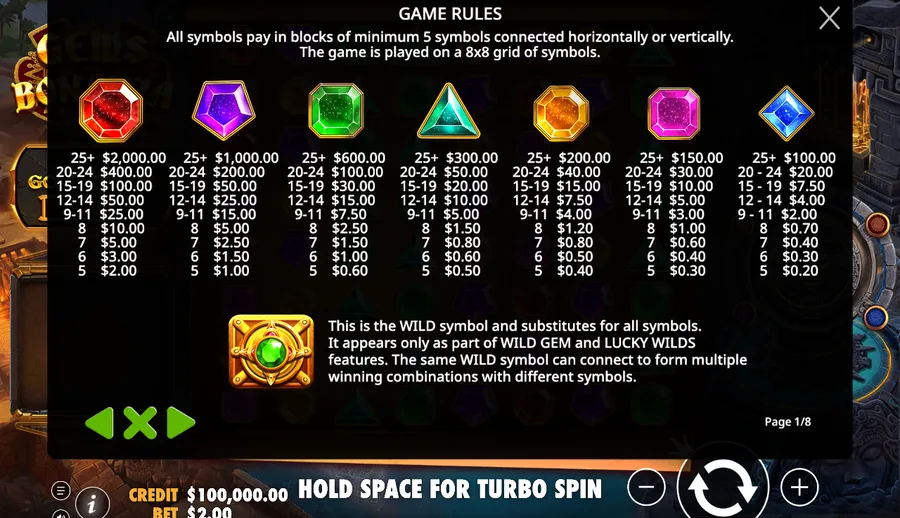
Seven gems pay in Gems Bonanza, and the pecking order runs from the red octagon at the top down to the blue diamond at the bottom. The figures below are the top-tier pays for a cluster of 25 or more gems at a $2.00 bet, straight from the in-game Game Rules panel. Smaller clusters pay proportionally less, stepping down through the 5, 6-14 and 15-24 bands.
The wild deserves its own note. It substitutes for every paying gem, but it only appears through the Wild Gem and Lucky Wilds features, never as a base symbol you can spin in on its own. Keep an eye on the RTP and max win too, because the same paytable behaves differently on the three RTP builds an operator can pick.
Top-tier gem pays (25 or more symbols, $2.00 bet)
Bold cells are the payout for the largest cluster band. These scale up or down with your stake, so the same table at a $20 bet would read ten times higher.
| Gem | Rank | Pay (25+ cluster, $2.00 bet) |
|---|---|---|
| Red octagon | Highest | $2,000 |
| Purple pentagon | 2nd | $1,000 |
| Green gem | 3rd | $600 |
| Teal triangle | 4th | $300 |
| Orange gem | 5th | $200 |
| Pink gem | 6th | $150 |
| Blue diamond | Lowest | $100 |
Only the highest win per gem type is paid, but separate clusters on the same drop stack together.
How to start playing
You can be spinning in under a minute. Here is the order we work through every time we open the game, whether in the demo or for real money.
1. Set your bet
Use the plus and minus controls to pick a stake between $0.20 and $240.00. Start low while you learn the tumble rhythm.
2. Check the RTP
Open the paytable at your operator to see which build you are on. The top version runs 96.55%, but some casinos serve 95.54% or 94.53%.
3. Spin
Press spin and let the gems land. Any cluster of 5 or more connected gems pays, then tumbles for you automatically.
4. Watch the markers
Coloured markers behind gems are your spin modifiers. When a win covers one, it fires and can reshape the whole board.
5. Track Gold Fever
The meter counts winning symbols within a single spin. Fill it to trigger the progressive feature, or buy it outright.
Bet range and stake steps
The Game Rules panel sets the minimum bet at $0.20 and the maximum at $240.00, though your casino can narrow that band, so do not be surprised if your operator caps it lower. That $240 ceiling is generous for a Pragmatic grid slot, but the smart move is to keep your stake small enough to sit through cold stretches, because the tumble game and the modifiers do most of the entertaining long before any big feature lands.
A few things to remember about staking here. Pays scale directly with your bet, so a $2 win at $0.20 becomes a $20 win at $2.00. The paytable figures above assume a $2.00 bet as the reference point. And autoplay is available if you want to run a set number of spins hands-free, which pairs well with a modest stake.
The bonus buy: 100x for Gold Fever
If you would rather not wait for the meter to fill, Gems Bonanza lets you buy your way straight into Gold Fever for 100x the base bet. In the demo at a $2.00 bet, the button reads "Buy Gold Fever $200", which is exactly that 100x multiple. It drops you into the progressive multiplier feature immediately, no meter-filling required.
Be clear-eyed about what you are paying for, though. Buying does not improve your odds inside the feature; it only skips the wait, and Gold Fever is a multiplier round that starts at x2 and can climb to x10 across five levels, not a free-spins bonus. Because the feature costs 100x and most sessions rarely clear past the early levels, we would not lean on the buy as a strategy. If you want the deeper maths, our Gold Fever bonus and max win pages break down every level. To feel the loop without spending, run the free demo first.
Before your first real spin
Learning Gems Bonanza is quick because the rules are honest: connect 5 gems, let them tumble, and hope a marker or the Gold Fever meter turns a small drop into a run. Set a stake you can sit with, confirm the RTP build at your operator, and treat the 100x buy as a splurge rather than a plan. Play the demo until the tumble rhythm feels natural, and compare it with games like Gems Bonanza if you want a different pace. Whatever you choose, this is a slot driven by an RNG, so set limits and treat every session as entertainment that carries real financial risk.